
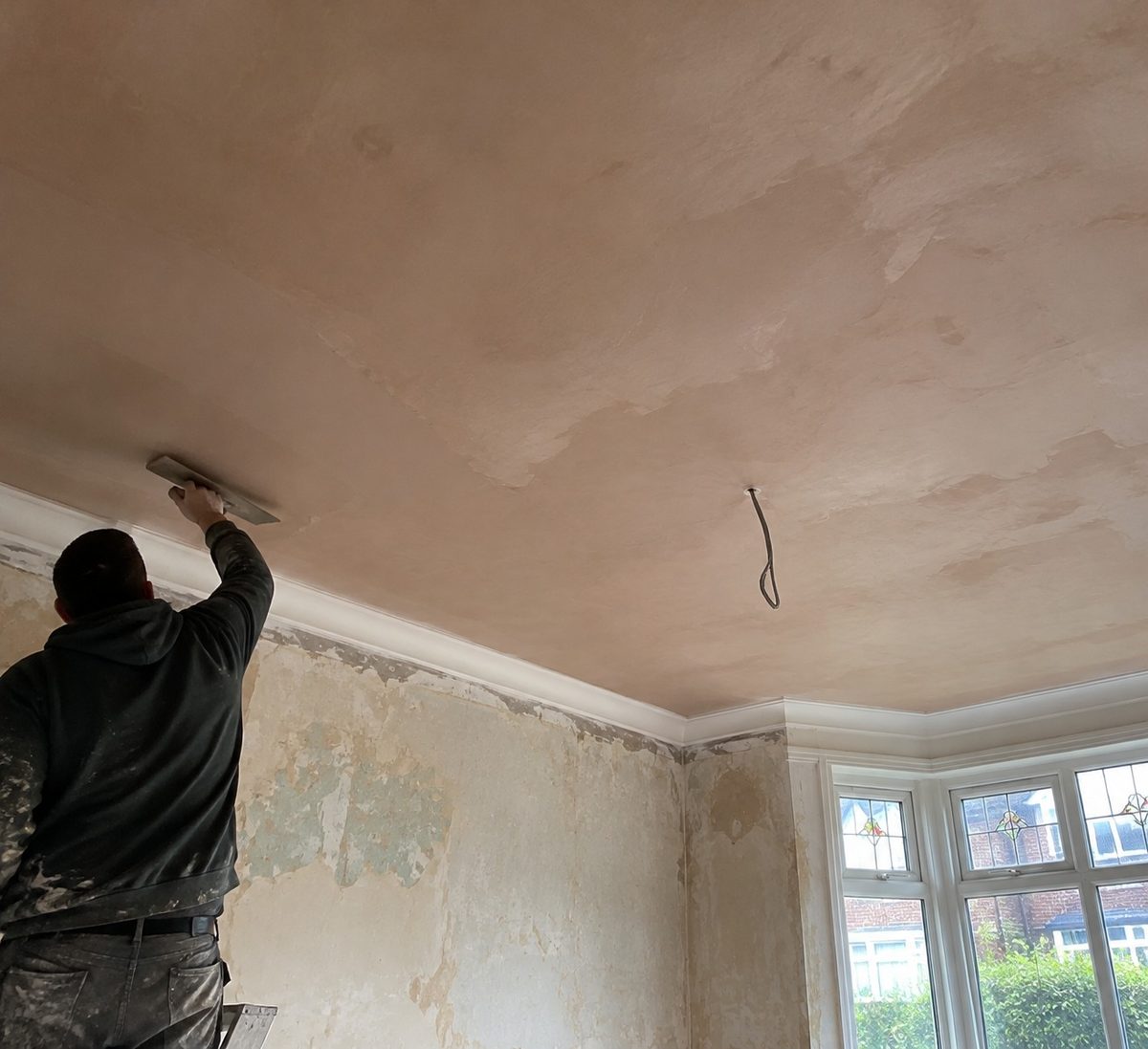
Tier 1 coverage, Merseyside
Plasterer in Bebington
Interwar semis at scale on tree lined roads, and Port Sunlight next door, where the plaster rules are not ours to set.
- Written quote
- Drying days given up front
- Floors covered first
Interwar semis, and plaster that is reaching the end of its life
Most of Bebington is between the wars: semis and detached houses on wide tree lined roads, built in a window where the walls might be solid brick or might be an early cavity, and where the internal finish was lime or early gypsum on brick with lath above.
Plaster of that age does not fail all at once. It goes hollow in patches where it has lost its key, usually above a radiator, around a chimney breast or along an external wall, and the rest of the room is fine. So the first question on a Bebington job is nearly always whether this is a patch, an overskim or a strip back to brick, and that is answered by tapping the wall rather than by looking at it.
Port Sunlight, where you cannot just use what is in the van
Port Sunlight sits inside Bebington and it is a conservation area of listed buildings. The cottages were built to breathe, with lime plaster inside and lime mortar in the walls, and they are protected.
What that means in practice is that gypsum is usually the wrong material there rather than merely a cheaper one. Put a non breathable finish on a solid lime wall and the moisture that used to pass through the surface has nowhere to go, so it sits behind the plaster and comes out as damp somewhere less convenient. Lime plaster costs more and takes longer because it goes on in coats that each have to carbonate.
Whether your property is listed, and what consent any particular work needs, is the council's answer. We will tell you at the quote whether what you are describing is a lime job so you can go and ask before anything is ordered.
Chimney breasts, alcoves and the thirties fireplace
A lot of these houses have had their original fireplace taken out, the opening blocked and the chimney breast patched, sometimes more than once and sometimes badly. What you get is a breast that is three different surfaces pretending to be one, which shows through paint under any light coming across it.
That is a re-skim job rather than a patch, with the alcoves taken in at the same time so the whole wall reads as one plane. It is also the moment to settle whether the vent for the blocked flue is staying, because a sealed flue with no ventilation is how you get damp in the breast.
Why the finish shows more here than people expect
The wide roads and big windows on these estates mean a lot of raking daylight across the walls, especially in the front rooms, and raking light is what finds a flat that is not flat. A wall that looks perfect under a ceiling light will show every trowel line at four in the afternoon in March.
It is worth agreeing at the quote which rooms are getting a finish you can paint straight and which are getting one that is going under paper, because they are different amounts of work and pretending otherwise just moves the argument to the end.
What Bebington asks for most
Skimming in Bebington
Interwar walls brought back to one plane in raking daylight.
Read moreLime plaster and lime render in Bebington
Port Sunlight and anything else that has to breathe.
Read moreCeilings in Bebington
Original ceilings in thirties semis.
Read morePlastering in Bebington
Chimney breasts and alcoves taken back to one surface.
Read moreAlso in Bebington: artex removal in Bebington, plasterboarding and dry lining in Bebington, external rendering in Bebington, k rend and silicone render in Bebington, render repairs in Bebington, pebbledash removal in Bebington, replastering after damp in Bebington, polished and venetian plaster in Bebington.
Questions from Bebington
Is my Port Sunlight cottage allowed to be plastered in gypsum?
That is the council's answer rather than ours, and worth getting in writing before anything is ordered. What we can tell you is the building reason behind the usual answer: the cottages were built with lime so the walls pass moisture, and a gypsum finish stops that happening at the surface, which tends to push the damp somewhere else in the wall.
How do I know if my wall needs a patch or a full re-skim?
Tap across it with your knuckles. A dull hollow note means the plaster has lost its grip on the brick there, and hollow areas have to come off whatever else happens. If it is one patch in an otherwise solid wall, that is a patch and a skim. If the hollow note is in several places, taking the wall back is usually the cheaper answer over ten years.
Can you skim over artex on a thirties ceiling?
Often yes, if it is sound and the pattern is not too deep. It is bonded first and then skimmed. Where the pattern is heavy, or where the ceiling is lath and has movement in it, overboarding gives a better flat and does not cost much more than fighting the texture.
Other areas covered
Twelve towns across the peninsula. The pages are not the same page with the name swapped: what is built in a place decides what the plastering job is, and a Birkenhead terrace and a Greasby estate semi are not the same job.
Across the Wirral peninsula
The west side and the coast
Get a price for a job in Bebington
Send a photo and a rough size and you will get a straight answer about whether it is a patch, a skim or a strip.
Get in touch
Tell us what the wall or ceiling is doing and roughly how much of it there is. A photograph on the form answers half the questions before anybody rings you back.
- Phone0151 453 8836
- Emailcontact@wirralplastering.com
- WhatsAppSend us a photo of the job
- Based inWirral, Merseyside
- HoursMon to Fri 8 to 6, Sat 8 to 2, closed Sunday