
Pebbledash
Pebbledash removal on the Wirral
Dash taken off and the wall rendered smooth, or rendered straight over where it is sound and keyed. Which one is right is decided by tapping it.
- Written quote
- Drying days given up front
- Floors covered first
Pebbledash removal
Off, or over, and how that is decided
There are two honest ways to get rid of the look of pebbledash. Take it off and render the wall smooth, or render over the top of it. They cost very different money and only one of them is right for any given wall.
Rendering over is cheaper, because nothing is coming off and nothing is going in a skip. It only works if the dash is genuinely sound and keyed, which is settled by tapping the whole elevation. Dash that sounds hollow has already let go and will take the new render with it, so on that wall the cheaper option does not exist.
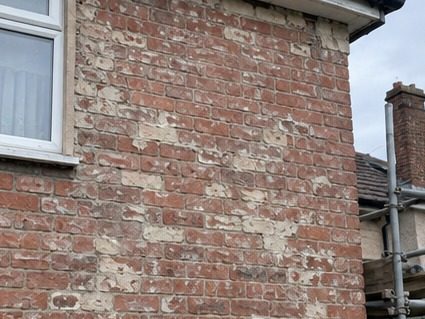
Taking it off is labour, waste and then a full render, and there is one more thing worth knowing before you commit. Dash was very often applied because the brickwork underneath was poor, soft or already damaged, so what is revealed is sometimes the reason it was covered in the first place. We would rather open a test area and show you than quote a smooth render and discover it on the second morning. Often asked about alongside lime plaster and lime render, replastering after damp and polished and venetian plaster.
Get a price for the dash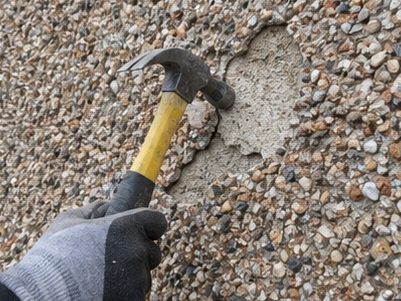
Tapped across the whole elevation. Hollow dash has to come off and the cheaper route is not available.
A test area opened before committing, because dash often went on to cover brickwork that was already poor.
Removal is a surprising amount of material. Skip, access and where it can stand are real lines in the price.
Done across Moreton, and everywhere else on the peninsula.
Pebbledash removal on the Wirral
What this job looks like
Example images of the kind of work described, each one labelled as such. They are not photographs of our own jobs and nothing here is borrowed from anybody else's. Our own photographs go in as jobs are finished and customers are happy for us to use them.
Why people use us
No surprises on the second morning
A test area is opened and shown to you before the whole elevation is committed to a method.
- Whole elevation tapped before a method is chosen
- A test area opened so you can see the substrate
- Both options priced where both are genuinely available
- Waste, skip and access shown as their own lines
Frequently asked questions
Pebbledash removal: the questions people ask
The ones that come up most. If yours is not here, ring and ask.
Is it cheaper to remove pebbledash or render over it?
Rendering over is cheaper when the dash is sound, because there is no removal and no waste. It is not an option at all on dash that is already hollow. Tapping the wall is what settles it and it takes minutes.
Will removing pebbledash damage the brickwork?
It can, and more to the point it often reveals damage that was already there. Dash was frequently applied to cover poor or soft brick. That is why a test area gets opened first rather than finding out across a whole gable.
Can the wall be left as bare brick after removal?
Sometimes, if what is underneath is in good enough condition, and it is worth asking because it saves the cost of rendering. More often the brick is not in a state to be left exposed, which is usually why it was covered.
Does rendering over dash look the same as removing it?
Once it is finished, a smooth render over sound dash looks like a smooth rendered wall. The wall gets slightly thicker, which matters at window reveals and at the roof line, and those details are part of the job rather than an afterthought.
Done across Moreton, and everywhere else on the peninsula.
Tap the wall and tell us what you hear
A dull hollow note in places means removal. A solid ring everywhere means you have the cheaper option available.
About Wirral Plastering
How the work is actually organised
Wirral Plastering takes the job as main contractor and puts the labour on it. That means one person quotes it, one person is answerable for it, and you are not chasing three numbers to find out who is coming on Tuesday.
It is worth saying plainly rather than implying a van and a family name, because the way a job is run changes what you can expect from it. What you get is a written scope, a date, and somebody whose problem it is if the date moves.
What we will tell you we are not
Damp proofing is a different trade and so is stone repair, and both come up constantly on Wirral housing. We do the plastering that follows damp work and the lime render that sits around stone, and we will tell you when the thing you are describing needs somebody else first.
Structural work is the same. A crack that runs in a line rather than a map pattern is not a plastering question and filling it is not an answer.
No photographs of our work, and why the site says so
There are no job photographs on this site. The slots are placeholders and they are labelled as placeholders. Nothing here is a stock picture presented as a job and nothing is borrowed from another company's gallery.
Real photographs go in as jobs are finished and customers are happy for us to use them, and not before. The same goes for anything that looks like a customer quote. There is a section built and ready for them, switched off, and it stays that way until there are real ones with permission attached.
Get in touch
Tell us what the wall or ceiling is doing and roughly how much of it there is. A photograph on the form answers half the questions before anybody rings you back.
- Phone0151 453 8836
- Emailcontact@wirralplastering.com
- WhatsAppSend us a photo of the job
- Based inWirral, Merseyside
- HoursMon to Fri 8 to 6, Sat 8 to 2, closed Sunday