
Tier 1 coverage, Merseyside
Plasterer in Birkenhead
The densest and oldest housing on the peninsula, which means lath and plaster ceilings, solid walls and salt in the bottom metre.
- Written quote
- Drying days given up front
- Floors covered first
Victorian terraces, and what is actually behind the wallpaper
Birkenhead went up fast and it went up early. Street after street of it is Victorian terrace and townhouse, and in a house of that age the walls are solid brick with lime plaster straight onto them and the ceilings are lath and plaster: thin timber laths nailed across the joists with haired lime pushed through the gaps to grip.
That construction decides everything about the quote. There is no cavity and no membrane, so the wall breathes and whatever you put on it has to breathe with it. And a lath ceiling that has started to go will usually be going in more than one place, because what fails is the grip behind the laths rather than the surface you can see. Pressing a ceiling with a flat hand tells you more than looking at it does.
Salt damaged plaster, and why the plastering comes last
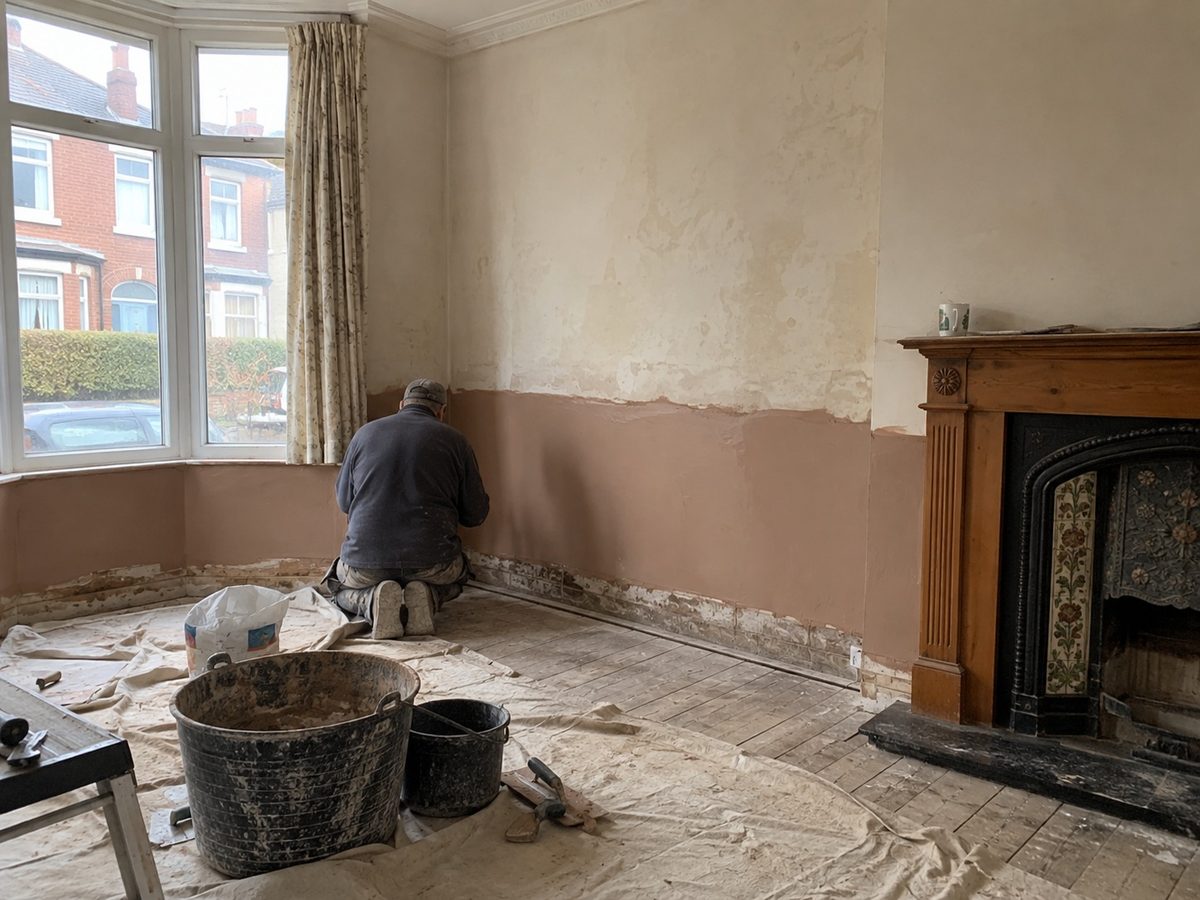
In the older streets the single most common call is the bottom metre of a hall or front room wall: blown, crumbling, a tide mark, paper lifting off it. That is usually salts drawn through the brick by damp, and they keep coming back through new plaster until the cause is dealt with.
So the order matters. Whoever is treating the damp does their work first, the wall is left to dry, and the replastering happens after that on a sand and cement render coat with a salt retardant rather than straight onto the brick in gypsum. We do the plastering half of that. The damp treatment is a different trade and we will say so rather than take the job and hope.
Hamilton Square and the streets around it
The Georgian terraces around Hamilton Square are a different problem again. Listed and conservation area work is not a matter of taste, it is a condition, and on those buildings lime is usually not a preference but a requirement: gypsum on a lime substrate traps moisture behind a face that cannot pass it, and the wall tells you about it within a winter.
Whether your particular property is covered is the council's answer and nobody else's. What we will tell you at the quote is whether what you are describing sounds like a lime job, so you go and ask the right question before anybody orders a bag of multi finish.
The commercial side of town
Birkenhead has a working centre as well as its houses: shop units, offices above them, and buildings that have been something else twice. Those jobs are mostly dry lining and boarding rather than solid wall work, they are usually to a date rather than to a standard of finish, and they often have to happen around somebody still trading.
They are quoted differently for that reason. Out of hours access, dust control and how much has to be made good at the end are the three things worth settling before anybody starts, not after.
What Birkenhead asks for most
Replastering after damp in Birkenhead
The bottom metre of a hall wall, once the damp has been dealt with.
Read moreCeilings in Birkenhead
Lath and plaster ceilings that have lost their grip.
Read moreLime plaster and lime render in Birkenhead
Solid wall and conservation area work that cannot take gypsum.
Read morePlasterboarding and dry lining in Birkenhead
Shop units and offices above them.
Read moreAlso in Birkenhead: plastering in Birkenhead, skimming in Birkenhead, artex removal in Birkenhead, external rendering in Birkenhead, k rend and silicone render in Birkenhead, render repairs in Birkenhead, pebbledash removal in Birkenhead, polished and venetian plaster in Birkenhead.
Questions from Birkenhead
Can you plaster straight over a damp wall in a Birkenhead terrace?
No, and nobody should. New plaster over an untreated damp wall will blow again, usually inside a year, and the salts come through the new finish. The damp cause is dealt with first by whoever is doing that work, the wall is given time to dry, and then it is replastered on a render coat with a salt retardant. We do the plastering part of that sequence.
Is my ceiling lath and plaster or plasterboard?
Press it flat handed. A lath ceiling gives slightly and sounds hollow and dull between the joists; plasterboard is firmer and sharper. If there is a loft above, looking down between the joists settles it: laths look like thin timber slats with lime squeezed through the gaps.
Can a lath ceiling be saved or does it all come down?
It depends on whether the keys behind the laths have gone. Where the grip has failed over most of the span it is cleaner and usually cheaper to take it down and board it, because patching a ceiling that is letting go in several places buys you a year. Where it is sound and only the surface is tired, an overboard or a re-skim is the lighter option.
Other areas covered
Twelve towns across the peninsula. The pages are not the same page with the name swapped: what is built in a place decides what the plastering job is, and a Birkenhead terrace and a Greasby estate semi are not the same job.
Get a price for a job in Birkenhead
Send a photo and a rough size and you will get a straight answer about whether it is a patch, a skim or a strip.
Get in touch
Tell us what the wall or ceiling is doing and roughly how much of it there is. A photograph on the form answers half the questions before anybody rings you back.
- Phone0151 453 8836
- Emailcontact@wirralplastering.com
- WhatsAppSend us a photo of the job
- Based inWirral, Merseyside
- HoursMon to Fri 8 to 6, Sat 8 to 2, closed Sunday